
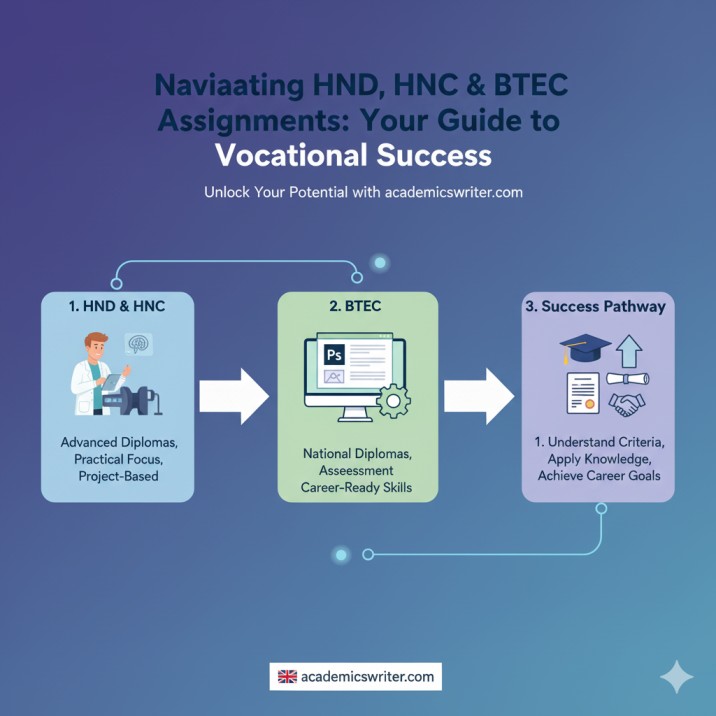
Navigating HND, HNC & BTEC Assignments: Your Guide to Vocational Success
In today’s fast-paced learning environment, vocational qualifications like Higher National Diploma (HND), Higher National Certificate (HNC), and Business and Technology Education Council (BTEC) courses have become more and more popular. These vocational degrees, in contrast to traditional degrees, emphasize practical, project-based learning to get students ready for the realities of working in fields like business, engineering, healthcare, and information technology, among others. The practical aspect of the study presents a problem for vocational qualifications. It can become very difficult to organize assignments, oversee real-world project procedures, and fulfill assessment requirements. In order to be confident, well-organized, and on track for career success, this guide will give you the skills you need to plan and finish your HND, HNC, and BTEC assignments.
Understanding How HND, HNC, and BTEC Qualifications Are Classified
Before talking about assignment approaches, it’s critical to comprehend the differences between these kinds of qualifications:
Higher National Certificate, or HNC: a longer, one-year program that is comparable to the first year of a university-level degree. This qualification covers the ideas and tenets associated with your field of study.Building on the HNC, the HND (Higher National Diploma) is a two-year program that offers more in-depth and practical learning opportunities.BTECs, which come in various study levels (for example, Advanced), blend classroom instruction with real-world assignments and projects.
Since all three of these are assignment-based rather than exam-based, students must apply their theoretical knowledge. This implies that having a strong research ability in addition to analytical and project management skills is crucial.
Major Obstacles Students Encounter
The following general problems are commonly encountered by students pursuing vocational qualifications:
Interpreting assignment briefs: It can be difficult to determine what the assessors are actually requesting.
Time management: It can be challenging to juggle part-time jobs, work placements, and homework. Putting theory into practice: It can be difficult to use what has been learned in the classroom to create solutions for real-world problems. Fulfilling the grading requirements: Making sure your final product demonstrates distinct connections and advancements through the related learning objectives. This is where HND assignment help, also known as HNC coursework help, could be very helpful in providing structure and clarity to the work effort needed to manage hectic workloads.
How to tackle project-based assignments
Projects and assignments that are reflective of the world of work are at the centre of vocational education. To recognize the appropriate scoping of assignments, you can:
Read the Assignment Brief Carefully
Each brief has essential elements, such as the task, learning outcomes, and assessment criteria. Break these elements down into elements that are manageable, and clarify anything you do not understand early on.
Research, Research, Research
Refer to academic references, industry case studies, and practical examples. This will strengthen your argument and provide evidence of applied understanding – this is often a key component of vocational grading.
Plan Your Structure
An assignment should present information in a logical progression of information.
Introduction – define the topic of the assignment and purpose.
Main Body – reference theory, apply models, and investigate real practice.
Conclusion – summarize insights and make recommendations.
At this point, students often benefit from support in vocational qualifications to ensure they have an appropriate flow and clarity.
Implement Real-World Scenarios
Whatever it may be, a business plan, marketing proposal, or engineering project, linking your work back to real-life instances can provide ‘realness’ and depth to your work. For instance, if you are completing an assignment on a BTEC Business module, it would be good to mention current market trends or company strategies.
Reference Correctly
Use the Harvard referencing system or another style for your course outlines. Referencing suggests academic integrity and will prevent plagiarism.
Tips for Writing in HND, HNC, and BTEC
The following is a selection of useful tips to apply to your assignments and help achieve success:
- Use Milestones
Take your academic work and divide the task up into smaller milestones—research, outline, draft, edit for structure, proofread, etc. You can avoid panic at the last minute by setting deadlines for all the mini-deadlines.
- Use Visually Representational Tools
Using charts, tables, and graphs is not simply to ‘fill up space’; they are simply a clearer analysis and provide you with an image of professionalism. They are strongly recommended, particularly for ATHE assessments and business modules.
- Relate Theory to Practice
Show your understanding by applying a practice example against the theory. For example, when writing about leadership styles, use a workplace case study to demonstrate the leadership styles observed in your work placement.
- Review Assessment Criteria
Typically, HND and BTEC courses will provide you with pass, merit, and distinction criteria. You can apply your academic writing to the highest level, demonstrating depth, creative application, and independent research, and detail the assessment criteria in your writing.
- Seek Feedback
Before submission, get a tutor, colleague, or mentor to read your draft. A second opinion can highlight areas for change and areas of improvement.
The Role of Professional Support
Numerous students avail HND assignment help, or BTEC assignment writing services, and/or professional writers and educators who are familiar with vocational assessment frameworks (such as Pearson or ATHE). They can help:
- Interpret difficult briefs.
- Offer you templates for reports or case studies.
- Provide editing and proofreading to ensure quality and/or academic standards.
- Support you in remaining half-original and structured.
Bear in mind: the notion of support is not to eliminate your work, but to maximize your understanding and improve your confidence in approaching coursework filled with projects.
Mistakes That You Should Avoid
By taking care to avoid these mistakes, you will avoid losing marks:
Ignoring the learning outcomes – always ensure that all your content matches the criteria.
Poor formatting- Understand the importance of presentation. Use headings, bullets, etc.
Late submissions- Be sure you manage your time appropriately if you want to meet tight vocational deadlines.
Plagiarism- Even if you paraphrase, you have to reference; you cannot take credit for sources.
Why Project-Based Work Advantages from Structural Guidance
Vocational tasks are practical in nature, but the structure makes them grounded in academic work. When your work is organized, it flows better and is easier for assessors to mark or assess your work. The structure of your work, whether it be framing for reports, project proposals, or reflective journals, ensures that you have your creativity and professionalism in your work.
In summary, project-based work thrives on sound planning, evidence-based research, and well-thought-out, reflective thinking.
Final Thoughts
HND, HNC, and BTEC assignments require a combination of academic rigour, creativity, and applied knowledge and insight. These qualifications are, in fact, your path to success in the real world, where valuable applied skills are required and recognized by employers.With a good understanding of structure, links to theory and practice, and the available resources (including Vocational Qualification Help, HN assessments guide, and ATHE assessments guide), each of Heather’s assignments can transition each assignment into an opportunity for insight and growth. Always remember, vocational learning is not just about gaining the unit, but instead laying the foundation for your own ongoing and enduring future professional lifetime success.
Frequently Asked Questions (FAQs)
- How does HNC differ from HND?
The HND is a two-year program that is more in-depth and frequently leads straight to the final year of a university degree, whereas the HNC is a one-year program that looks at basic skills.
- Are assignments for BTEC more challenging than those for conventional exams?
Not at all. BTEC assignments evaluate your application of theories, not just your memorization of them. Assignments demand constant work and critical thinking.
- What are the guidelines for the ATHE assessment?
Vocational learners can evaluate their work using a framework and standards provided by ATHE (Awards for Training and Higher Education). Adhering to ATHE’s as
assessment guidelines provides a framework for your work and link it to the official academic work standards.
- How can I get help with my BTEC or HND assignments?
Seek out professional academic services, tutors, mentors, or online tertiary education tutors with vocational education training for assistance with HND assignments or BTEC coursework.
- How can I differentiate my vocational assignments?
A clear structural layout, industry-specific examples, reliable sources, thoughtful analysis, and a professional presentation with referencing are all important.
Written by Insha


