
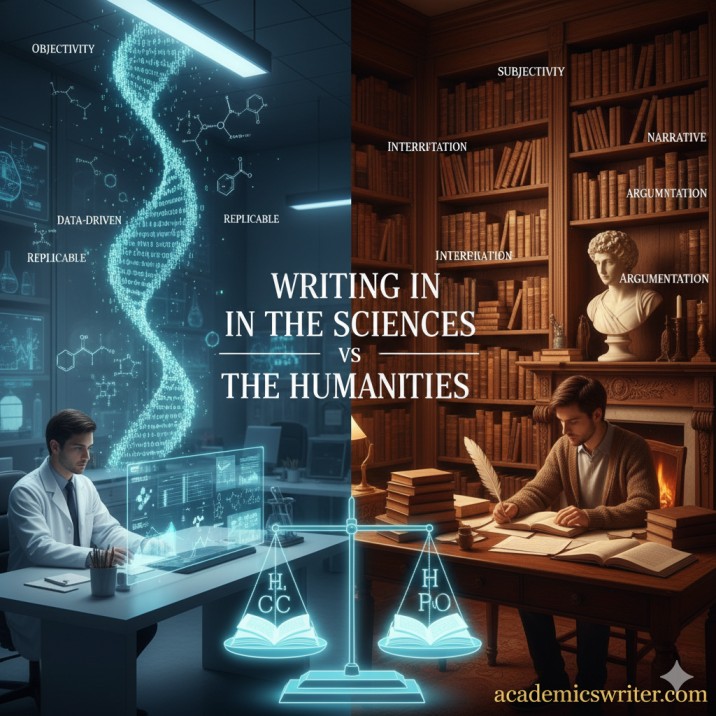
A Clear Comparison
What if you are an excellent student in the Science subject and you get higher grades in this subject, your presentations and assignments are always well-prepared, and you take feedback from your supervisor seriously? Your results are to the point, all things are doing great, but among your subjects, there is one compulsory subject that is completely different, a subject that focuses on writing. For example, you receive an assignment asking you to write a 2000-word literature essay on Shakespeare’s concept of ambition, and the deadline is very short.
Since you have no interest in this field or subject, this situation being caught between these two assignments, will feel like living in two completely different worlds. That’s because the writing pattern of Science and that of Literature are entirely different and highlight very distinct human perspectives.
It’s these differences that help us understand why writing in science feels so different from writing in the humanities, and that’s what we’ll explore here..
Science Writes Facts, Humanities Build Arguments
The main difference between writing in science and the humanities is simply the style of expression. When you write a science lab report, your main goal is to clearly describe the process and its results and explain the reasons behind them. There is nothing personal to be said; we only write about things that can be observed, measured, or repeated.
For example, I share my experience. I was in my psychology session, and here I focused on collecting results based on an observation, not your thoughts, personal interpretations
On the other hand, in humanities essays, such as those in English literature or history, the goal is to present an argument. Here, you try to convince the reader through logic and evidence that your interpretation or position is acceptable. You also respond to what other writers have said, sometimes agreeing with them and sometimes offering your own way of looking at the same idea.
In short:
The purpose of scientific writing is to report reality.
The purpose of humanities writing is to interpret reality.
2. Structure IMRaD vs Argumentative Flow
If the purpose of writing is to convey knowledge, as in science, then the structure of the writing will be simple. And if the purpose of writing is to present an argument, as in the humanities, then the structure of the writing will be based on logic and argument.
The IMRaD Structure In Scientific Writing
Scientific writing follows the IMRaD structure, it is usually has four main parts.
- Introduction: explain the background and why the study was done.
- Methods: Details the working procedures and materials.
- Results: Note down your analysis in the report’s
- Discussion: explains the theory with reason and summarizes the result.
For example, suppose you are preparing a Chemistry Lab Report, and you write that the reaction rate increased proportionally with temperature. Now, does this seem like an argument to you? Or does it look like you are expressing someone else’s opinion? No, it’s simply an experiment, and you are writing in the report about the data you obtained from it. Do you understand what I mean?
The IMRaD structure keeps the way of writing straightforward, concise, and factual, meaning it doesn’t contain unnecessary words or emotional language. The reader can easily find the information they need without having to read additional explanations, fancy words, or unnecessary things.
The Argumentative Model in Humanities Writing
Humanities essays don’t follow IMRaD. Instead of they rely on argumentative flow.
- Introduction: Given a clear argument to explain your essay theme.
- Body paragraphs: Each argument explains with an idea or supported evidence.
- Conclusion: End of the writing summarized in a short version.
If you were writing a philosophy essay, you might explain that Aristotle’s virtue ethics still matters in today’s world since they puts more weight on a person’s intention than the outcome.
3. Tone and Style based on Objective vs Subjective Writing
The Language of Objectivity In Scientific Writing Style
In scientific writing, the writer does not reveal their personality or opinions. His job is only to present facts and data clearly and accurately. That is, when a scientist writes a report, he does not use words like I did this or I think this The focus in his writing is on the experiment and the results, not on the writer.
The purpose of using Passive Voice in science reports is to focus on the Experiment, not the writer. If we write I heated the solution to 60°C the focus shifts to the person, that is, who did the work. But when we write The solution was heated to 60 °C, the focus shifts to the work, that is, what happened. This style of writing is used so that the writing appears objective and unbiased, and the reader trusts only the data and experiment, not the writer’s opinion or action.
In modern scientific writing, the active voice, such as We tested the sample is sometimes allowed, but the basic principle remains the same: the writer’s focus is not on himself but on the data and results. That is, the data is the most important thing in the report, and the writer remains in the background. The reader should feel that the results presented are absolutely true, unbiased, and reliable, and not that the writer has written according to his personal opinions or biases.
The Voice of Interpretation In Humanities Writing Style
In humanities essays, the writer’s voice, that is, his style of expression and thinking, is very important. Here, subjective analysis is not only accepted but expected.
Here, subjective does not mean unreliable, but rather your own thinking based on argument and logic. You present your perspective, support it with evidence, and also acknowledge alternative views.
For example, Shakespeare’s Hamlet, though a revenge story, also explores the inner conflict between emotion and conscience, a new perspective on the same text.
- Evidence Data vs Textual Interpretation
Evidence is the basis for the truth and confidence of any research or written statement. That is, if you want to prove something, evidence is necessary for it. But in each field, such as in sciences and humanities, Evidence has a different meaning. In science, evidence is data, statistics, and experiments. While in the humanities, evidence is based on texts, ideas, and interpretations. Whether scientists or humanities researchers, the main goal of both is to understand reality or truth through their own methods.
5. Writing Process Experimentation v Reflection
Science Writing Process
The process of writing in science mostly occurs after the experiment. It is a straightforward and organized (Linear) process:
- Experiment
- Analyze data
- Get results
- Write a report
When you sit down to write, you know your result in advance. That is why the focus is on Accuracy and Organization.
The Humanities Writing Process.
WWriting in the humanities is itself part of the thinking process. Students usually start with a question, not an answer. As you write a first draft and then revise it, your argument gradually develops. For example, a philosophy student asks the question, What is justice? And then refines and clarifies their position through discussion and evidence.
6. Learning to Write Across Disciplines
At first glance, science and the humanities may seem to be written in two different languages they each has its own language. But in reality, the same thing is required to write well both the writing must be clear, logical, and evidence-based.
If you understand one field, such as science or the humanities, your ability to write in the other field will also improve.
For example,
- A sociology student, a humanities subject, can present scientific data in a way that makes his arguments seem clearer and more compelling. Similarly, a medical student can explain difficult scientific matters to laypeople more easily if he uses a humanities writing approach.
Many of today’s new disciplines, such as psychology, linguistics, and environmental science, combine these two styles. To write well in these disciplines, you need to understand both the data-based thinking of science and the analytical thinking of the humanities.
Put simply:
If you learn to combine the writing styles of both science and the humanities, your writing will be stronger, more intelligent, and more effective.
7. Conclusion:
When you spend time in the lab preparing reports and writing theory based on the results, and then you have to take a theoretical subject that changes the way you think, Science and Humanities start to feel like two completely different worlds. Science purpose of science is to describe reason with logic and evidence, while the humanities involve discussions throughout the article. You already know what both mean and what their purposes are.
Science writing teaches to talk to the point based on a result that is seen with your eyes. It’s about describing exactly, but Humanities writing pushes you to think deeply, to express, and to feel the essence of the research itself. If you understand both, you will become a good student, as well as you can also become a person who understands things wisely and learns from both perspectives.
For international students studying at UK universities, it is essential to learn how to strike a balance between objective and subjective writing. That is, when you move from a scientific style of writing, which is based on facts and figures, to a humanities style of writing, which is based on opinions and emotions, this is not your weakness; it’s your strength. It shows that you can adapt your thinking to different subjects, and build a bridge between the two, on the one hand, what is known knowledge and facts, and on the other, what is understood. I hope you have better understood this article’s point of view so Best of luck for your future!
Written by Mahnoor Nadeem Ahmed