
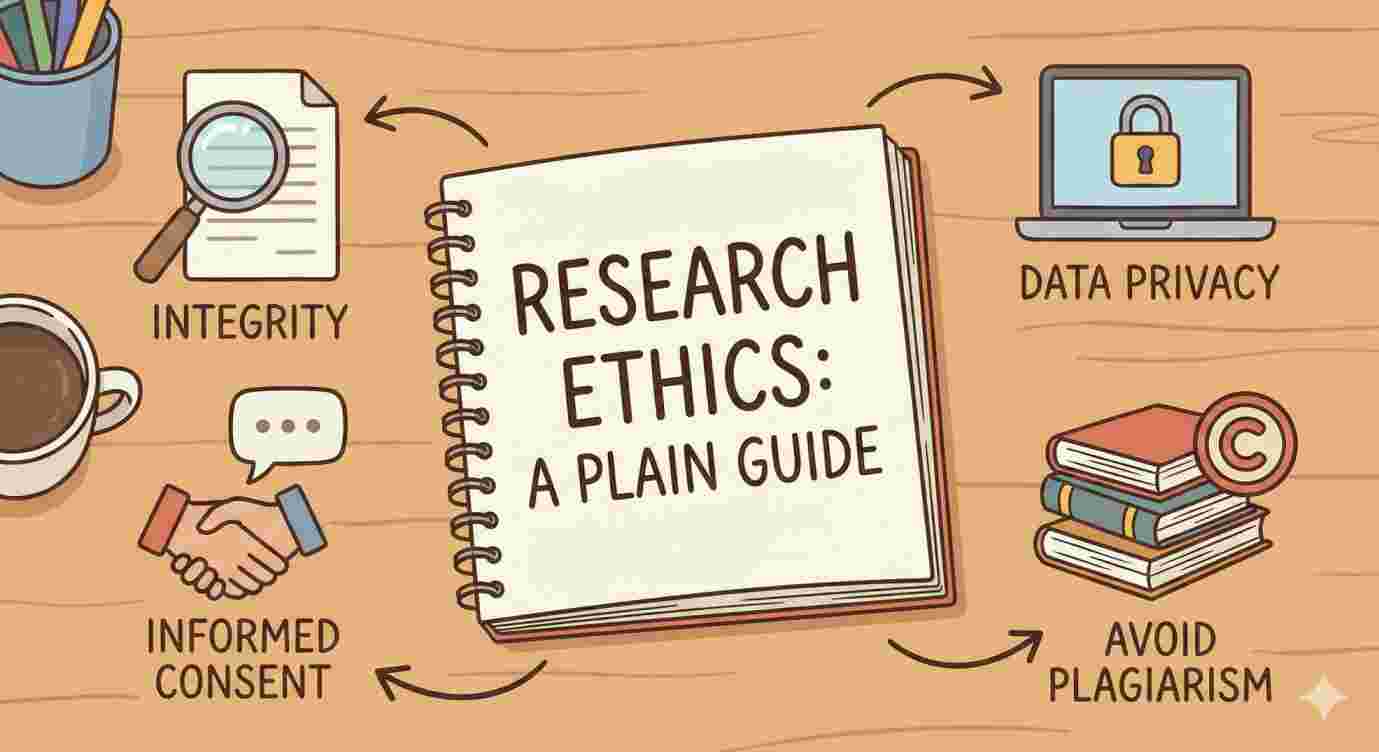
What is Research Ethics? A Plain English Guide for Students
Imagine you are sitting in a university café, your laptop open, and you are about to send out a survey to your classmates asking them questions about their study habits. Before you send out the survey, a question comes to mind: What if someone’s answer reveals their identity? Or what if I use their data in a way they did not intend? That’s when research ethics comes into play. That is, research ethics are the principles and habits that make certain that you treat your participants with respect and responsibility, keep their data safe, work with their consent, and respect their privacy.
Introduction
Many students collect data from classmates or strangers without knowing the ethical rules they should follow. The questions come to mind, such as:
- Am I allowed to do this?
- Can I use people’s answers as I please?
- What if someone later regrets participating?
The purpose of this article is to explain research ethics in simple language, especially for students. It explains what you should keep in mind when conducting research, such as:
- Informed Consent
- Anonymity
- Confidentiality
- Data Storage
- Research Integrity
If you understand these principles, you will be able to conduct your next research or survey with honesty, responsibility, and awareness.
1: Why Ethics in Research is Important
Ethics in research are important because they ensure that research is conducted in accordance with ethical principles and rules, which in turn provide the respect, rights, and confidentiality of participants. Research is conducted with honesty, truthfulness, and transparency. Simply put, when we collect information from people, we should take their feelings, safety, and privacy into account. The data we collect should be accurate and reliable and should not be misused.
Participants should be told in advance how their data will be used, that is, they should be given informed consent, and their permission should be obtained. This builds trust in research, and public support for research projects increases. Student Survey Example
Suppose you are working on your dissertation or research project. You decide to create an online survey, asking your fellow students questions about things like
- Sleep patterns
- Digital distractions like the impact of mobile or social media
- Mental health
- Academic performance
You create a Google Form, share the link on social media, and ask 200 students to fill out the form. Everyone fills out the form willingly, and you think everything is fine.
But wait, a few ethical questions arise:
- Did the participants understand what you would use their data for?
- Is it possible for their identity to be revealed?
- Can their answers be identified?
For example, if someone writes: I am a 22-year-old third-year student in the Psychology department, and there is only one such student in the entire department,
- Can you guess who that person is?
- Where will you store the data?
- On your laptop, on a shared drive, or as a printout?
- And who will have access to this data?
- If a participant later says they want their data removed,
- Do you have a system in place to delete that data?
- When you publish or share your results?
- Will any individual’s identity be revealed in any way?
All these questions are actually the basic principles of research ethics.
Research ethics means that while doing research, you should take special care of responsibility, transparency, and respect. Protect the privacy and rights of participants,
and use their data honestly and securely.
Now we will go ahead and understand these ethical pillars in detail, so that students can practically implement them in their research.
2: What Do We Mean by Research Ethics?
Research ethics refers to the principles that guide the conduct of research. This question actually tells us how we should plan our research, how to conduct it, how to analyze the data, and how to write and report the results.
Students, these principles are typically encountered during surveys, interviews.
Key ideas you will encounter are:
Research Integrity: Be honest, accurate, and clear in your work.
Participant Consent: Make sure people join voluntarily and know what’s involved.
Data Protection: Keep collected information safe, organized, and remove it when needed.
Other Key Concepts: Include anonymity, confidentiality, informed consent, right to withdraw, and avoiding harm. Consent, Right to Withdraw, and Avoiding Harm. All these principles are considered the fundamental pillars of research ethics.
3: Things to Know About Research Ethics
The basic ethical principles are the important ethical rules that every researcher should try to follow. Different organizations define these principles in their own ways, but they have the same goal to ensure that research is conducted honestly and fairly. The first one is that:
Participating Voluntarily with Consent
This means that people should participate in the research of their own free will and pleasure, and no one should be forced to participate. Participants should be told what the research is about, what types of questions will be asked, how their answers will be used, how long it will take, and whether there are any risks or benefits. The research should only begin when participants understand everything and give their consent.
Minimizing harm and risk
The researcher should consider whether any questions will cause anyone pain, stress, or embarrassment, or violate anyone’s privacy. And if there are any risks, every effort should be made to minimize them.
Anonymity and Confidentiality
Anonymity means that you do not collect any data that can identify the participants. That is, no names, roll numbers, or any personal information are included, so no one can be identified from the data.
Confidentiality is a little different in that you may know the names or codes of the participants, but you promise not to reveal their identities to anyone and to keep their data in a secure place.
For example, if you ask for names, roll numbers, and departments in your survey, this data will not be anonymous. But if you replace the names with codes and keep the original information locked in a separate file, then you have maintained confidentiality.
4: Handling Surveys, Interviews & Experiments Ethically
- Different research methods:
- Surveys: online or paper-based questions
- Interviews: face-to-face, recorded, or notes
- Experiments: using participants or changing variables
For surveys:
They are easy and quick, and can be shared online. Be ethical: participants should be anonymous/confidential, have a page, can withdraw consent at any time, and should not collect unnecessary personal information.
Collecting IP addresses or tracking info without telling them in an online survey can compromise anonymity.
For interview:
This is more personal. If recording is being done, ask participants for permission first, and explain what will happen to the recording, where it will be stored, and when it will be deleted. Use a pseudonym instead of a name, and offer them the opportunity to view the transcript if they want. Also, be aware of your influence as a researcher, and ensure that participation is completely voluntary.
For experiments:
You may need to use participants or change variables. Make sure no one is hurt or harmed, and explain and debrief all participants. If deception is required (rare), justify it and explain it fully later. Be fair in participant selection, don’t just choose friends or people who are easily available, or the results may be biased.
5: Student Guide to Safe Data Handling
As a researcher, you may not have the resources of a larger institution, but that doesn’t mean you should neglect your responsibilities. Where possible, use university drives or platforms rather than personal mobile phones or laptops. Always use strong passwords and encrypt data if possible. Also, make sure that only those who really need to access the raw data have access—usually just you and your supervisors.
It’s also a good idea to keep a simple record of who has seen the data and when. Plan for later deletion of the data: remove all identifying information when your research is classified or published, unless participants have permitted a longer period. If you are sharing data, make sure it is completely anonymized, meaning it doesn’t contain any individual’s name or any identifying information. And if you use cloud storage, make sure it complies with the university’s data protection policies.
6: Some Myths About Ethics Explained
People often have misconceptions about research ethics. To clarify a few key points. Some people think that ethics is just extra paperwork that slows down the work, but the truth is that these same safeguards make your research stronger and more reliable. Many people also think that if all you’re doing is conducting a simple survey of friends, then why bother with ethics? But issues like consent, privacy, and data use are important in any case, especially when you plan to publish the results. Another common misconception is that anonymity and confidentiality are considered the same, even though anonymity means that no identifying information is collected at all. In contrast, confidentiality means that the information exists, but you are obligated to keep it safe. Finally, the idea that data can be stored for as long as you want is also not right; Keep data only as long as needed, then delete it safely unless participants agree to keep it longer.
Conclusion
Just because you are a student doesn’t mean ethics take a back seat. Paying attention to research ethics helps you build a strong foundation for all aspects of your academic journey. For example, if you are handling a new university environment, as discussed in A Guide for International Students: Understanding UK Academic Culture, thinking ethically will help you interact respectfully with peers. When using tools like AI to support your work, like in A Student’s Guide to Using AI Tools Ethically and Effectively, research ethics ensures you handle information responsibly. If you are exploring sources beyond the library, as in Beyond the Library: Mastering Digital Research Skills, or incorporating feedback from your supervisor, like in From Draft to Distinction: How to Effectively Use Supervisor Feedback, ethical considerations guide how you collect and use data accurately. Managing your time and stress, as in How to Beat Burnout: A Realistic Guide to Managing Academic Stress, and preparing presentations that reflect your effort, like How to Give an Academic Presentation That Gets You a First, also benefit from an ethical mindset. Even when writing in different fields, whether in the sciences or the humanities, as in Writing in the Sciences vs The Humanities, research ethics reminds you to respect your participants, your sources, and the integrity of your work. Always ask yourself: Am I doing right by the people and information behind this research? Keeping this question in mind makes your research responsible, reliable, and purposeful.
Written By : Mahnoor Nadeem Ahmed


