
Introduction
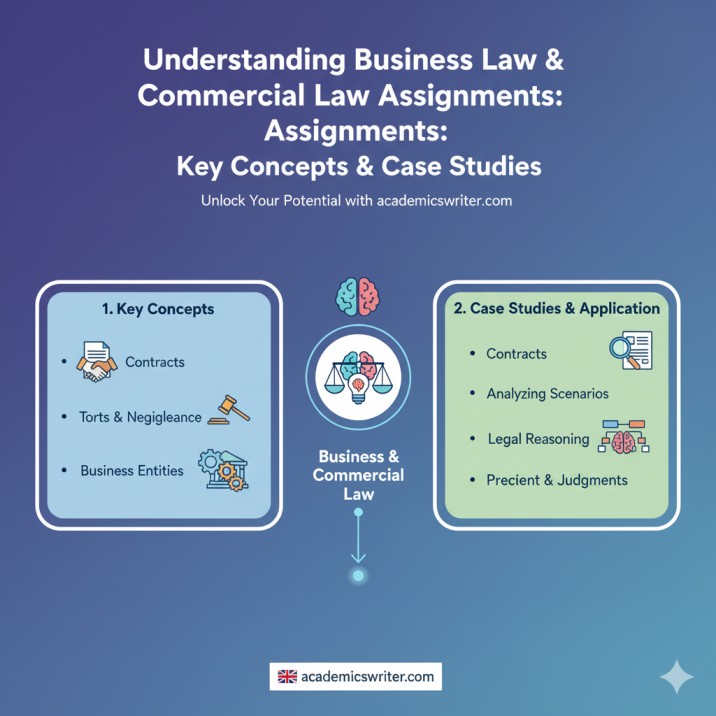
Legal studies represent some of the most challenging yet engaging fields in which students can study. When approaching business law and commercial law assignments, success does not rely on memorising statutory material more than it does on critical interpretation, applied skills, and case study reasoning in the classroom. Whether you are approaching contract law assignments, researching company law, or writing a commercial law essay, having a clear and methodical appreciation of conducting case analysis and applying legislation can have a significant impact on your results and understanding of the material. In this article, we will discuss the fundamental concepts, writing considerations, and practical examples to help you with business law assignment help and enhance your understanding of legal principles.
What is business law?
Business law, otherwise referred to as commercial law, is about the activities that involve trade, commerce, and the management of a business. Business law covers rules that regulate how businesses operate, enter into contracts, resolve disputes, and protect intellectual property.
Some of the key topics in the business law field include:
1)Contract law – deals with agreements between parties and their enforce ability.
2)Company law – the structure, duties, and liabilities of companies.
3)Employment law – the rights and obligations between employer and employee.
4)Consumer protection law – concerned with fairness in business transactions.
5)Intellectual property law – protects original work and branding.
6)Within the UK domain, statutory instruments like the Companies Act 2006, Sale of Goods Act 1979, and Consumer Rights Act 2015 are ‘pillars’ which students often research for legal assignments.
The Nature of Commercial Law Assessment
In an essay on commercial law, students are often required to assess business transactions according to the law. Generally, these tasks will assess your ability to interpret legislation and apply it to an example of a business dispute.
Typical assessments for commercial law include:
1)Case analysis (analyzing a legal precedent such as Carl-ill v Carbolic Smoke Ball Co.)
2)Problem-oriented question (applying the law to a hypothetical situation)
3)Research reports (discussing recent developments in company law or trading regulation)
4)Critical essays (assessing the extent to which certain laws protect consumers or shareholders)
5)Commercial law assignments require the integration of theoretical knowledge with practical examples and reference a relevant statute or case law to substantiate your response.
Key concepts to understand
- Contract Law and its Concepts:
A contract forms the basis of most business relationships. For an agreement to be categorized as a contract, it must include:
1)Offer and acceptance presentation – both parties must agree.
2)Consideration – as in something of value being exchanged.
3)Intention to create legal relations.
4)Capacity and legality.
One of the classic stare decisis cases in UK Law is Carl-ill v Carbolic Smoke Ball Co. [1893] 1 QB 256, which established that an advertisement can constitute a binding offer if it is clear that the intention is to be legally bound by the offer. In assignments involving topics of contract law, a student should consider using cases such as this to justify and explain their arguments in such assignments clearly.
- Company Law: The Corporate Veil
Company law deals with the formation and management of members or shareholders in a corporation and the dissolution of that corporation. The concept of the corporate veil separates the identity of a company from its owners. This is conceptually important, and in cases of fraud or misconduct, courts may “lift the veil.”In Prest v Petrodel Resources Ltd [2013], the UK Supreme Court clarified the role of the corporate veil and when it may be appropriate to pierce it. Understanding these decisions distills your understanding of company law in research, while also honing your legal reasoning.
- Legal Interpretation and Statutory Analysis
Correctly interpreting legislation is key to any assignment related to UK legal studies or any assistance concerning this area of study. Legal interpretation requires an analysis of:
The literal rule – look to the words of the statute.
The golden rule – arrive at a sensible reading of the statute and avoid absurd results.
The mischief rule – consider what the law was designed to remedy, or what the law ‘intended’.
For example, while interpreting the Street Offences Act in Smith v Hughes (1960), the court focused on the spirit of the law, or the mischief rule, rather than the literal wording of the law. This case is a stark example of how legal interpretation can factor into the decision of the case.
Case Study: Contract Dispute in Modern Business Environment
Let’s look at a short case study that might be relevant in a business law assignment.
Case: Jet2.com Ltd v Blackpool Airport Ltd (2012)
Issue: The airline sought to claim breach of contract after the airport refused to accept late evening flights.
Ruling: The court ruled that there was an implied obligation for the airport to act in good faith, given the commercial context of the agreement.
Lesson: Contracts are more than just written words, and must be interpreted in terms of the business realities and parties’ expectations. Such a case study could be relevant in a contract law assignment to demonstrate analytical consideration of legal issues.
Creating Good Work in Business Law
When writing your business law assessment, detail and order are paramount, and we recommend following these steps:
- Understand the Asking
You must read very carefully whether it is asking for evaluation, analysis, or discussion.
Each of these has a different level of argument.
- Research Legislation and Case Law
You can use good, credible sources of law literature located in legal databases such as West-law, Lexis-Nexis, and BAILII (British and Irish Legal Information Institute). When you are using case law, ensure that you always reference correctly, using the Harvard or OSCOLA format.
- Use the IRAC Method for Structure
Use the IRAC model to structure the paragraphs in your assignment:
- Issue: State the legal question.
- Rule: State the law or precedent.
- Application: Apply the law to the facts.
- Conclusion: State the conclusion.
- Be Analytical Instead of Descriptive
You will need to analyse how the law applies instead of just stating the law. For example, saying that “contracts require consideration” is not enough to earn marks; instead, you should explain, “Consideration usually means benefits or detriments exist between the parties, to ensure fairness between the parties.”
- Professional and Formal
Formal, precise, and objective are the qualities of legal writing. Avoid emotional language and personal references to your life experiences.
Challenges students face
Students commonly encounter difficulties with:
1)Understanding complicated language in legal materials.
2)Utilizing and referencing multiple statutes in relation to a single case.
3)Correctly referencing legal cases.
4)Writing in succinct and fulfilling word counts.
Therefore, many learners seek to obtain business law assignment experts or professionals who are highly knowledgeable in the field of legal studies in the UK. Legal writing requires not only understanding, but also accuracy, some of which may be enhanced and improved through professional aid.
Why Legal Specifics Require Expert Guidance
Commercial law essays are unlike typical essays; they require significant ongoing interpretation of legislation, where a slightly misinterpreted fact can change the meaning of the entire answer. This is why students are encouraged to always verify facts (applying reliable sources) and to seek expert assistance when in doubt.
Professional legal writers/tutors can help in ensuring:
– Proper legal reasoning.
– Correct statute and case citation.
– A logical structure and professional form.
Legal particulars require special care, and that’s the value of expert business law assignment help service to improve the accuracy and polish your work.
Conclusion
Completing business and commercial law assignments is more than just learning legislation or cases; it is about understanding how the law works in real business reality. Whether you are analyzing a contractual dispute, writing about corporate structures, or reviewing the law of trade, the application of theory into practice is what distinguishes great work. If you develop your own abilities in case analysis, legislative interpretation, and critical reasoning, you will find writing in law to be gratifying and intellectually stimulating. Law matters, too. It is indicative of your learning, commitment to formal legal practice in your future.
Written by Insha